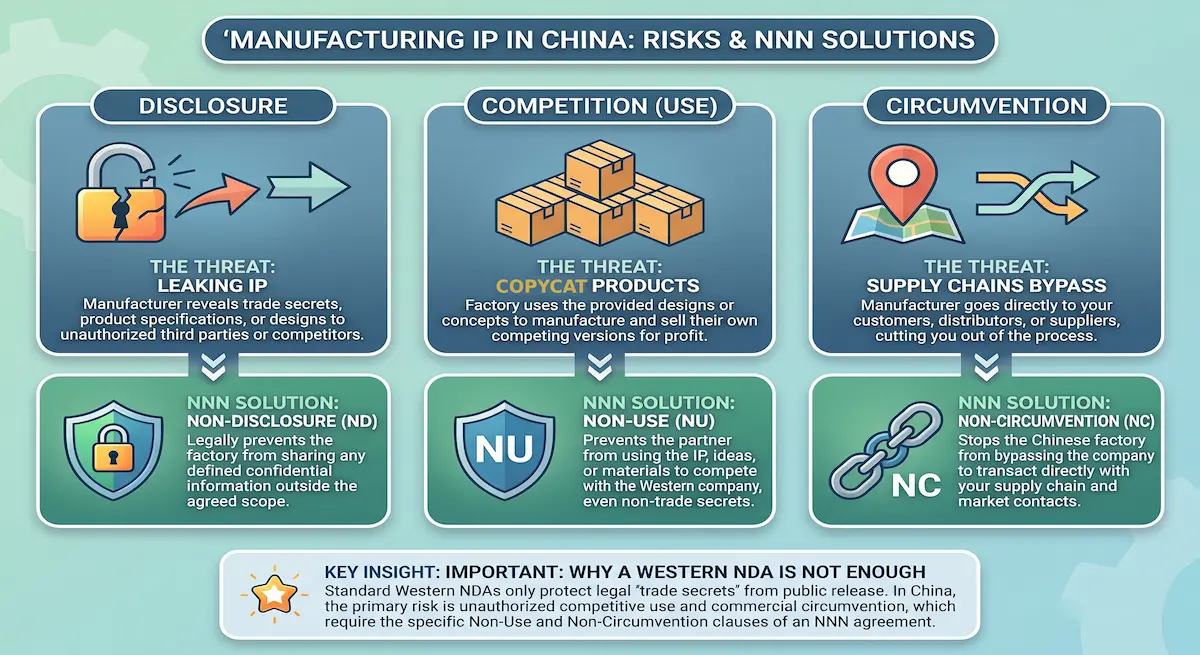
If you are having a product made in China, the single biggest risk you face is not an unknown company stealing your idea - it is the factory you hired deciding to make and sell your product itself — or selling it straight to your customers. A Western-style Non-Disclosure Agreement is almost useless against that. An NNN Agreement is built for it.
Why a Standard NDA Isn't a Good Idea in China
An NDA drafted for a US, UK, or EU counterparty is designed for a legal system that will never touch your Chinese supplier. When you drop that document into a China relationship, it typically fails in four structural ways.
Most NDAs are not enforceable in Chinese courts
Most NDAs specify foreign governing law and a foreign court or arbitral seat. Chinese courts generally will not enforce a foreign court judgment, and your supplier almost never holds assets outside China. A judgment from a court in London or New York is, in practical terms, a piece of paper the factory can ignore.
An NDA only bans DISCLOSURE — not USE, and not COMPETITION
An NDA stops the other side from telling third parties your secrets. It says nothing about the factory using your designs to build its own version, or going around you to sell to your customers. In China, this is the actual threat, and a pure confidentiality clause does not address it.
It's in the wrong language and the wrong legal concepts
Chinese courts operate in Chinese. An English-only contract must be translated by a court-appointed translator you do not control, and can be challenged or effectively rejected as evidence. Even bilingual contracts that say “English controls” often see the Chinese text prevail in practice. Western legal boilerplate frequently has no equivalent under Chinese law.
It leaves you to prove your losses from scratch
Without a pre-agreed damages figure, you must prove your actual financial loss — which is extraordinarily hard when a factory quietly copies a product. No agreed number means no leverage and a slow, expensive, uncertain claim.
Example
What an NNN Agreement Is
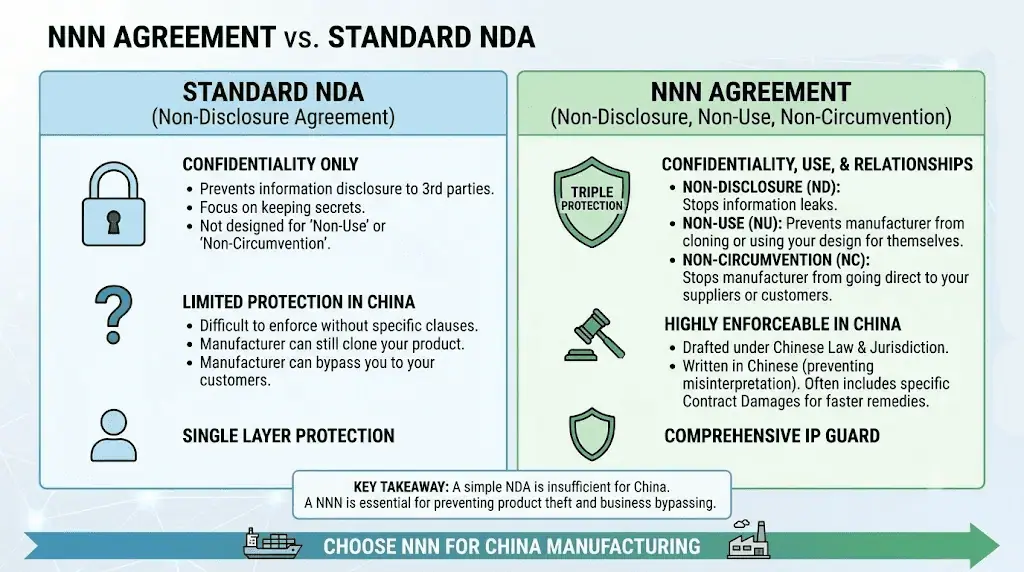
NNN stands for Non-Disclosure, Non-Use, and Non-Circumvention. It is a single agreement, written for Chinese law, in Chinese, and designed to be enforced against your Chinese counterparty in a Chinese court or arbitration — the only forum with real power over that company. It replaces the NDA; it is not an add-on to it.
Non-Disclosure
The factory cannot pass your confidential information — drawings, specifications, customer lists, pricing — to anyone else.
Non-Use
The factory cannot use your information for its own benefit — it cannot make your product for itself, for a competitor, or for the open market. This is the clause an NDA lacks.
Non-Circumvention
The factory cannot go around you to reach your customers or suppliers and sell to them directly, cutting you out of your own supply chain.
Example
What makes those three promises actually enforceable is the machinery around them: Chinese governing law, a Chinese controlling-language text, a Chinese court or CIETAC arbitration clause, the counterparty's exact registered Chinese name and Unified Social Credit Code, and — critically — liquidated damages. We cover each below.
What Must a NNN Agreement Contain?
A properly drafted NNN does three things a Western NDA cannot: it is enforceable where the factory's money and machines actually are, it targets the real risk (the factory becoming your competitor), and it creates deterrence before anything goes wrong. A factory that knows a Chinese court can freeze its accounts for a pre-agreed sum behaves very differently from one holding a foreign NDA it knows is toothless.
That protection only holds if the document contains the right elements. At minimum, an effective NNN Agreement should include:
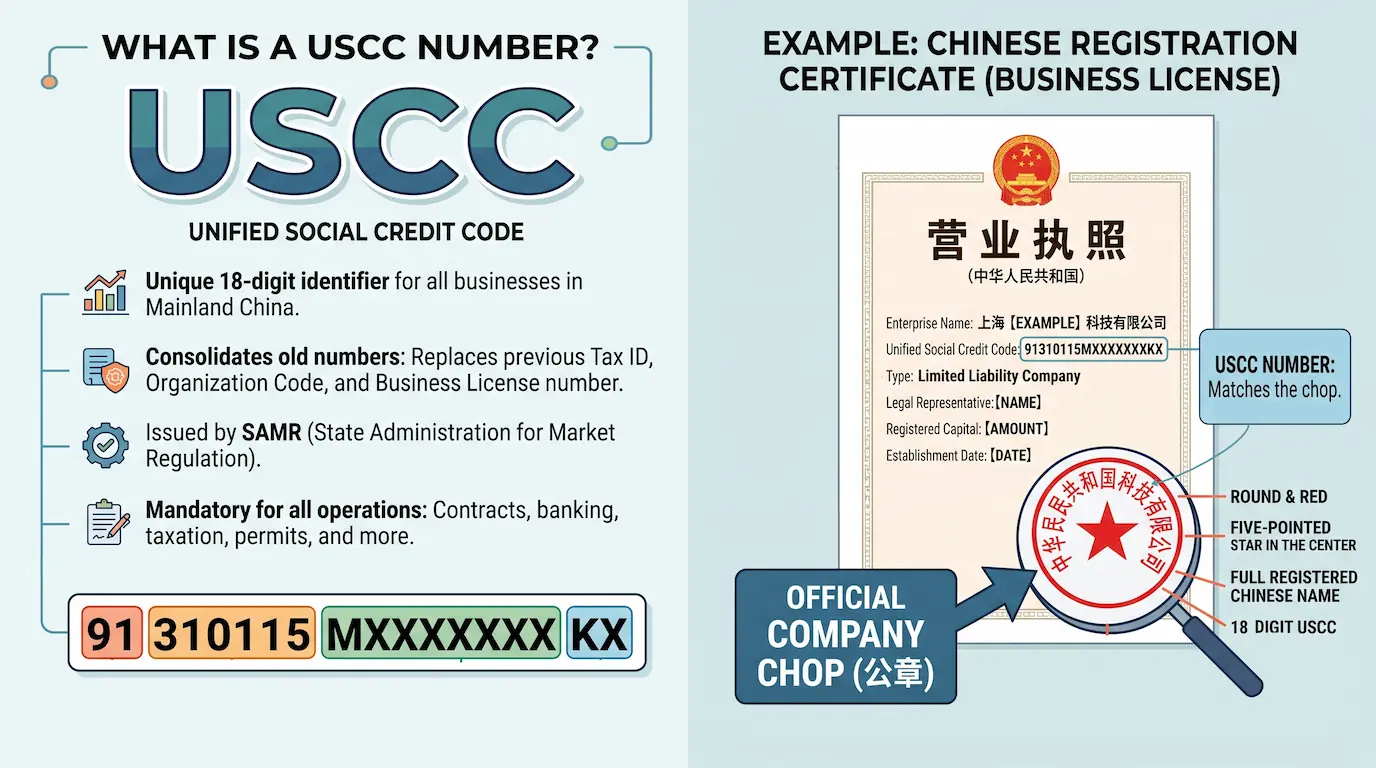
The correct parties — legal Chinese name + USCC
The English trading name on a website is not the legal entity. The agreement must name the factory's exact registered Chinese company name and its Unified Social Credit Code (the 18-character USCC). Get this wrong and you may be holding an agreement against a company that does not legally exist.
Chinese governing law and Chinese jurisdiction
Chinese courts apply Chinese law. Specify Chinese law and either a competent Chinese court or arbitration seated in China (commonly CIETAC) so a judgment or award can be enforced directly against the counterparty.
Bilingual text with Chinese as controlling
Provide English so you understand what you sign, but make the Chinese version the legally controlling one. This removes translation disputes and matches how Chinese courts actually read contracts.
A precise definition and scope of confidential information
Chinese courts read confidentiality narrowly. Define what is protected, mark it, and attach a product schedule (an appendix describing exactly what the factory is and isn't allowed to make).
Explicit non-use and non-circumvention obligations
Spell out that the factory may not manufacture your product for anyone else and may not approach your customers or suppliers. Do not leave this to be implied.
Liquidated damages
A defensible, pre-agreed sum payable on breach, so you are not left proving losses from zero. Covered in detail in the next section.
Asset preservation and injunction rights, term and survival
Preserve the right to seek asset freezes and injunctions, and make the obligations survive the end of the commercial relationship — the risk does not end when the orders stop.
Build an NNN Agreement with all of these clauses
Our guided builder produces a bilingual, China-law NNN Agreement with the correct parties, controlling-language settings, and configurable liquidated damages — no legal drafting required.
Create your NNN AgreementLiquidated Damages: The Clause That Gives an NNN Teeth
Liquidated damages are a fixed sum the parties agree in advance will be payable if the factory breaches. They matter enormously in China because proving your actual loss after a covert copy is nearly impossible. Under Article 585 of the PRC Civil Code, parties may agree such a sum, and Chinese courts routinely enforce reasonable liquidated damages — giving you a concrete number to sue on and, just as importantly, real deterrence up front.
The number has to be defensible
Article 585 also lets a court adjust the figure. If the agreed amount is “excessively higher than the loss actually suffered,” the breaching party can ask the court to reduce it. In practice, Chinese courts often treat an amount more than 30% above the actual loss as presumptively excessive and subject to reduction. Set it too high and a court may cut it; set it too low and it neither deters nor compensates.
Example
Defensible: a figure tied to a rational basis — for instance a multiple of the total contract value, or a sliding scale reflecting the scale of the breach — so the number tracks the realistic commercial harm.
Calibrating that figure is exactly where importers get stuck. Our free tool helps you model a defensible liquidated-damages amount before you finalize the agreement.
Liquidated Damages Calculator
Model a defensible penalty figure based on your order value and risk — before it goes into your NNN.
Pre-Disclosure Enquiry Letter
Before you disclose anything, send a free bilingual letter to verify the factory's business licence, USCC and company chop.
China Is Not the Wild West Anymore
The biggest risk to your IP in China is not the Chinese legal system — it's your own contract.
The received wisdom about manufacturing in China hardened around 2010, forged by hard lessons learned by importers in fields like drop-shipping: you hand your drawings to a factory, and within eighteen months you are competing against your own product, made on your own tooling, sold to your own customers, with no realistic remedy. For a long time that was a fair description — we advised on hundreds of cases that fit it exactly. But that “wisdom” is now roughly a decade out of date.
Three things have changed: the law, the damages, and the machinery for extracting a payout without a court case at all.
What has not changed is that none of it works automatically. It works for companies that put themselves inside the Chinese legal system on purpose — which, for most importers, means a properly drafted NNN Agreement, in Chinese, governed by Chinese law.
What actually changed in the law
The turning point was the 2019 amendment to China's Anti-Unfair Competition Law (AUCL). It did three things that matter to anyone handing technical information to a supplier:
Punitive damages
Courts may award one to five times the base compensation where misappropriation is in bad faith and serious in nature.
A higher statutory ceiling
The cap for cases where actual loss cannot be proven rose to RMB 5 million.
A conditional shift in the burden of proof
Once a rights-holder shows it took reasonable confidentiality measures and produces preliminary evidence of infringement, the alleged infringer must show it did not misappropriate. This is not an automatic reversal — the rights-holder still has to build a prima facie case — but in a system with no US-style discovery, it is the single most consequential procedural change of the last twenty years.
A newer, quieter change: administrative enforcement
A further development has gone largely unnoticed in the West. On 1 June 2026, the State Administration for Market Regulation (SAMR) brought into force new Provisions on the Protection of Trade Secrets, giving foreign small businesses administrative enforcement routes — including injunctions and fines of up to RMB 5 million — without ever filing a lawsuit.
The damages are no longer symbolic
The old complaint about Chinese IP enforcement was never that you couldn't win. It was that winning was worthless. Two Supreme People's Court judgments have ended that argument.
Geely v. WM Motor
Supreme People's Court (IP Tribunal) · 2024
Around forty senior staff moved from Geely to rival EV maker WM Motor, taking new-energy-vehicle chassis technology with them. The court of first instance awarded RMB 7 million. The Supreme People's Court awarded RMB 640 million, applying punitive damages — a roughly ninety-fold increase and, at the time, a record.
Jiaxing Zhonghua Chemical v. Wanglong Group (the 'vanillin' case)
Supreme People's Court · 2021
Zhonghua, then the world's largest vanillin producer, protected its manufacturing process as a trade secret rather than patenting it. Wanglong misappropriated the process and took roughly 10% of the global market, cutting Zhonghua's share to around 50%. The first-instance court, applying the pre-2019 law, awarded RMB 3 million — the statutory maximum then available. On appeal, the IP Tribunal calculated the infringer's profits from actual sales volume and the rights-holder's own margins. This is precisely the category of process know-how that importers hand to contract manufacturers every day.
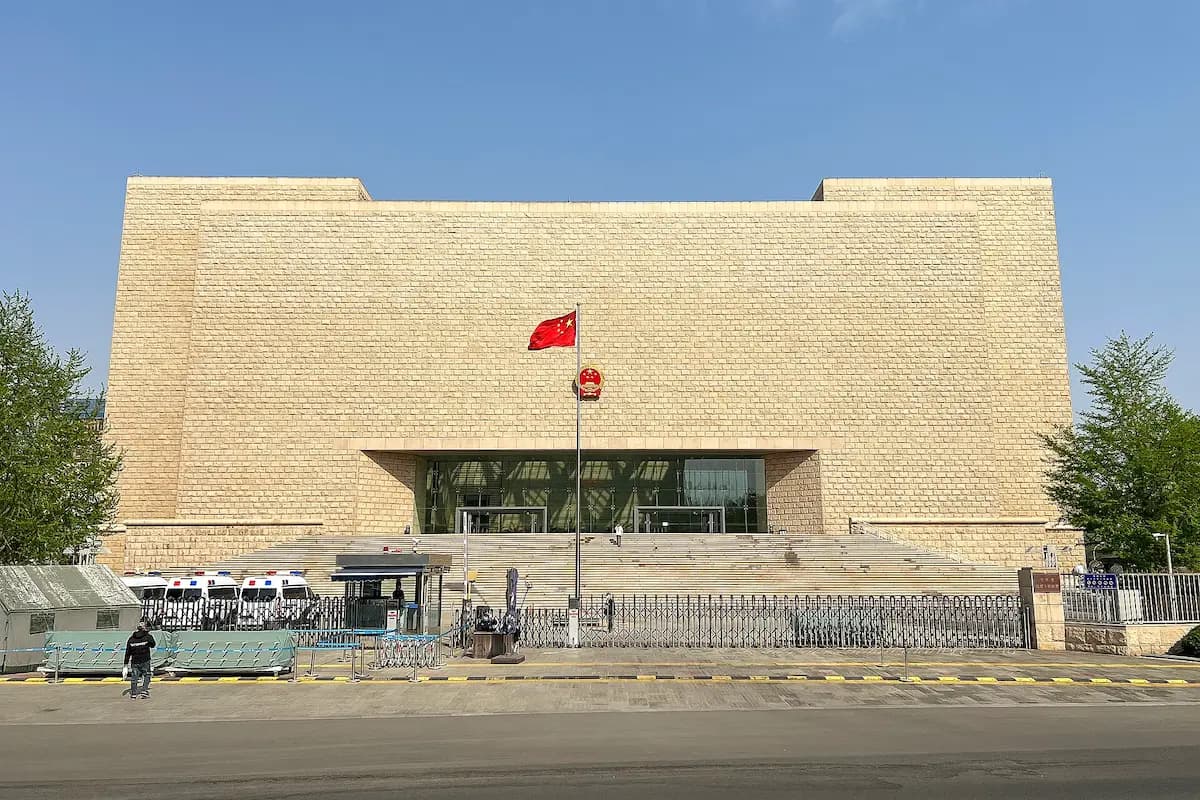
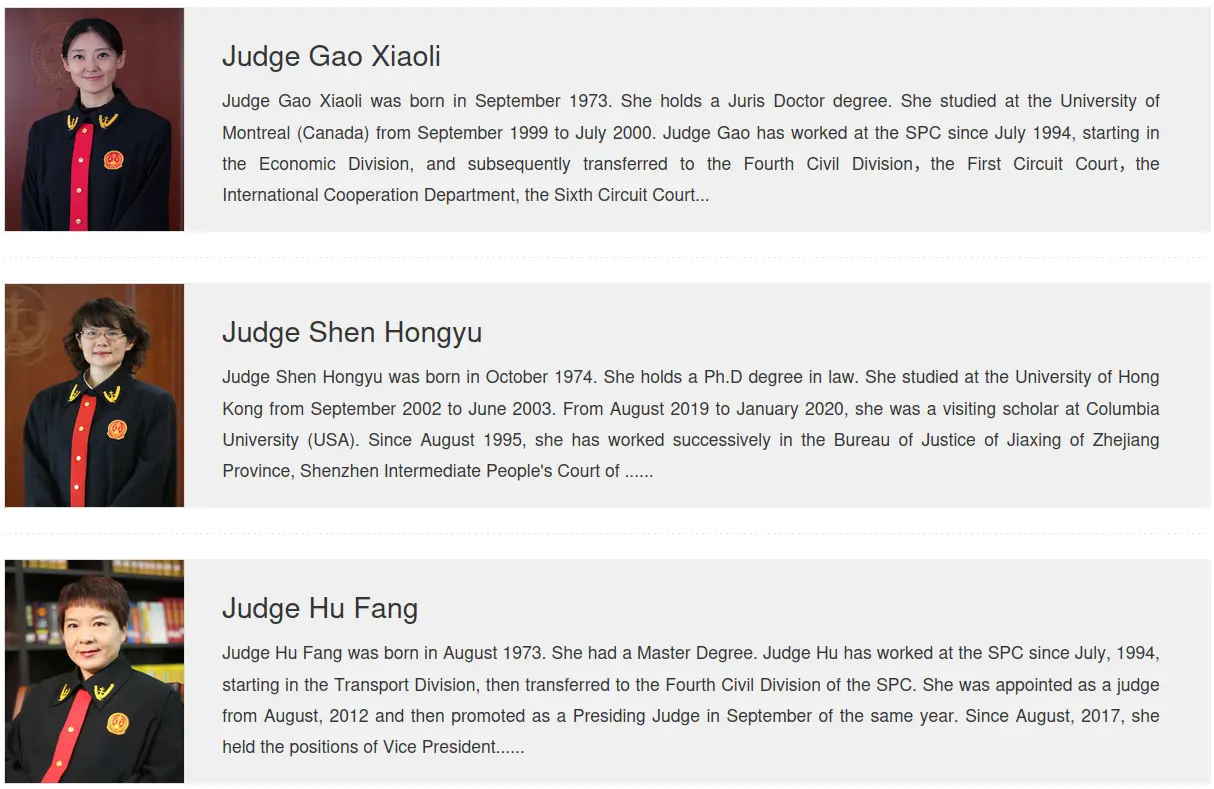
The Chaoyang District People's Court in Beijing, the building may look unfriendly, but the judgments are increasingly favoring foreign companies.
Do foreign companies actually win?
A survey by the Chaoyang District People's Court in Beijing covering 2014–2022 found foreign plaintiffs suing domestic entities succeeded in roughly 77% of 117 adjudicated cases. Beijing IP Court data, excluding disputes where both parties were foreign, puts foreign litigant success at around 68% — higher than the rate for purely domestic disputes. Foreign-related cases make up 30–40% of that court's docket, and the SPC's IP Tribunal has handled over 2,500 foreign-related cases since 2019, growing at an average of 18.7% a year.
77%
Foreign-plaintiff success rate, Chaoyang District People's Court, Beijing (2014–2022, 117 cases)
68%
Foreign-litigant success rate, Beijing IP Court — higher than purely domestic disputes
2,500+
Foreign-related cases handled by the SPC's IP Tribunal since 2019, growing ~18.7%/year
The individual results back this up:
Sichuan Golden-Elephant Sincerity Chemical
Supreme People's Court
A foreign-invested melamine producer combined patent and trade-secret claims against infringers of its pressurised gas-phase quenching technology. Lower courts were unfavourable; the SPC overturned them and granted enhanced remedies, awarding RMB 218 million. A follow-on suit settled for RMB 440 million within months — because the listed defendant had to disclose the judgment publicly.
Siemens
Siemens obtained RMB 100 million against a counterfeiter that had set up a shell company to disguise its role — an award above the statutory maximum, granted partly because the defendant refused to produce its financial data.
Where the NNN Agreement fits
Every case above was won by a party that had positioned itself to win: Chinese-language documentation, confidentiality agreements signed in advance, a Chinese forum, and evidence that could be preserved by court order. That is the entire function of an NNN Agreement.
An NNN — Non-Disclosure, Non-Use, Non-Circumvention — differs from a Western NDA in what it prohibits. An NDA stops your supplier telling others. It does not stop the supplier using your design to build a competing product, and it does not stop the supplier selling directly to your customers on Alibaba or Amazon. Non-use and non-circumvention are the two clauses that address what factories actually do.
The strategic point is that a properly drafted NNN gives an importer two independent routes, not one:
1. A contract claim
Breach of the agreement, with liquidated damages under Article 585 of the Civil Code. This requires no proof that the information qualified as a “trade secret” and no proof of the exact quantum of loss — removing the two hardest evidentiary hurdles in the system. It also supports a pre-judgment asset freeze, which in practice is where most of the leverage lives: Chinese courts are far better at seizing assets than at policing conduct.
2. A trade-secret claim
Where the information does qualify, the AUCL remedies above remain available — including punitive damages, which contract law does not provide.
Our NNN Agreement — and What It Includes
Our NNN Agreement is built to include everything covered in this guide, generated through a guided form and delivered as a professional bilingual PDF. You answer plain-English questions; the document is assembled with the China-law provisions already in place.
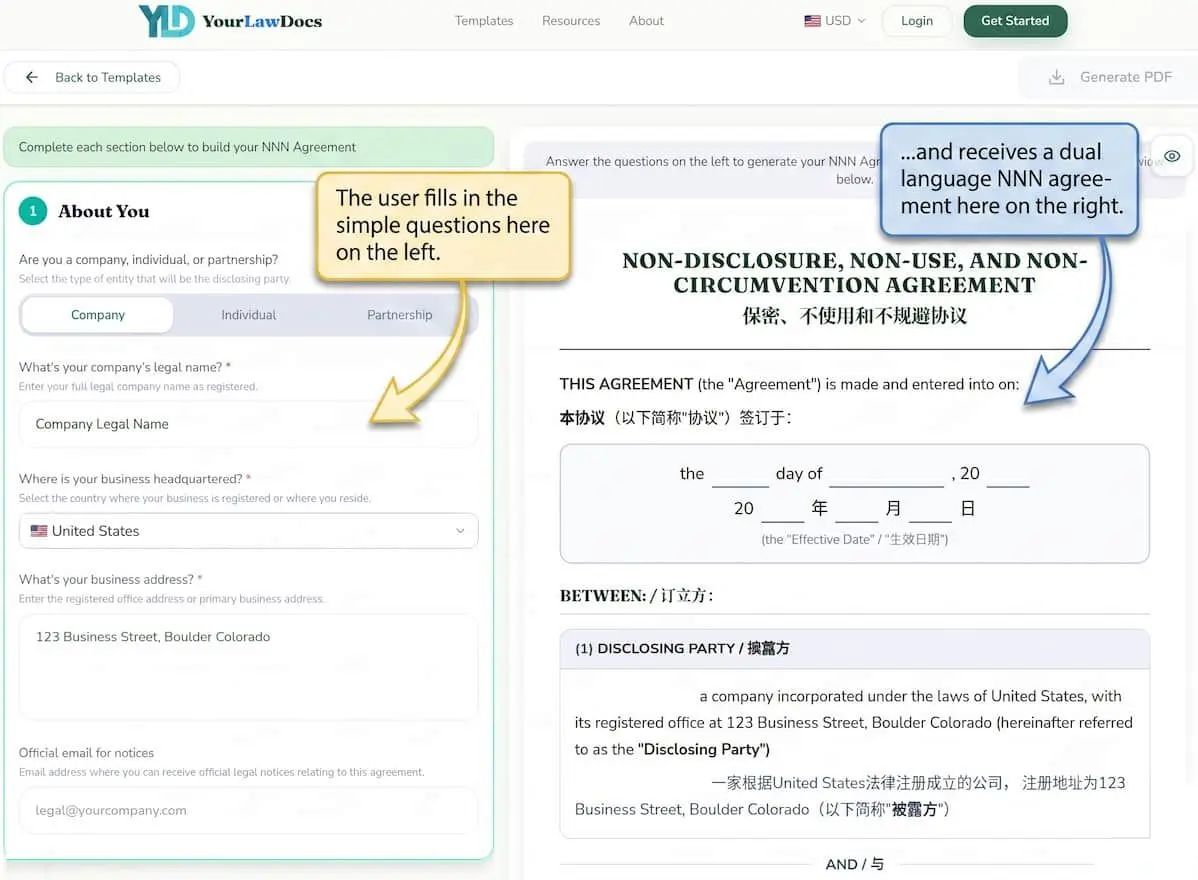
Bilingual, Chinese-controlling
Full English and Chinese text, with the Chinese version set as legally controlling.
Correct parties with USCC capture
Records your details and the manufacturer's registered Chinese name and 18-character Unified Social Credit Code, with validation.
Non-disclosure, non-use, non-circumvention
All three core obligations, drafted for enforceability under Chinese law.
Configurable liquidated damages
Choose from three models — a fixed amount, a multiple of contract value, or a sliding scale — to keep the figure defensible.
Product schedule (Appendix A)
Attach a precise description of the product so the scope of what the factory may not make is unambiguous.
Dispute resolution built in
CIETAC arbitration with your choice of one arbitrator (faster, lower cost) or three (for complex disputes).
Term, renewal and survival
A fixed term with optional auto-renewal, and obligations that survive after the relationship ends.
Optional protections & lawyer review
Add late-delivery penalties, product-liability insurance and commercial terms, or opt into review by a China-law attorney.
Protect your product before the next order ships
Create a bilingual, China-enforceable NNN Agreement in minutes. Configure your liquidated damages, name the right parties, and generate a ready-to-sign PDF.
Start your NNN AgreementSources & further reading
- Herbert Smith Freehills Kramer — Geely v. WM Motor, record-breaking trade-secret damages (2024)
- China Justice Observer — The Vanillin case (2021)
- Bird & Bird — Hefei Meyer medical-device trade-secret case (2026)
- Covington & Burling — 2019 Anti-Unfair Competition Law amendment (punitive damages, burden-shifting)
- Civil Code of the PRC, Book III (Contract) — Article 585, liquidated damages
This guide is general information about doing business in China and is not legal advice. Case outcomes depend on their specific facts. For advice on your situation, consult a qualified China-law attorney.